Wordle Solver — Entropy-Based Word Guessing Tool

🧠 Wordle Solver — Intelligent Word Selection System
A web application built with React (Next.js), designed to efficiently select possible words in the Wordle game.
The system analyzes user input (correct, partially correct, and excluded letters) and uses an entropy-based model to select the optimal next word.
🛠️ Technologies
- Frontend: React, TailwindCSS, Shadcn/UI
- State & Hooks: useState, useEffect, useCallback, custom useWordleSolver
- Libraries: Lucide React Icons
- Data Storage: JSON (word dictionary)
- Input & Logic: manual and automatic input, filtering, auto-inference
🔢 Algorithms & Logic
🧮 Entropy — The Core of Intelligent Selection
Based on Shannon's entropy formula:
$$undefined$$
Where:
- — probability of a result (letter layout),
$$undefined$$
meaning the proportion of remaining words
that produce the same pattern when compared to the current guess (e.g., 🟩⬜🟨⬜⬜) - — entropy: the expected amount of information
$$undefined$$
the word provides. The higher the entropy, the more it
narrows down possible options — making it a more "informative" word.
Each candidate word is evaluated based on how well it splits the remaining dictionary.
The higher the entropy, the more value it provides.
🧠 Behavior:
-
Input:
- 5 Correct cells (exact positions)
- 5 Misplaced cells, each accepting up to 24 letters (letters are in the word, but not in those positions)
- Excluded row — letters definitely not in the word
-
Automatic exclusion of letters from previous guesses if they were neither green nor yellow
-
Support for the official Wordle dictionary (New York Times)
-
Fast filtering and entropy calculations — all computed client-side
🖼 Application Interface
The UI is designed to be intuitive even for beginners.
The system automatically suggests starting words, filters the dictionary based on input, and displays the optimal next guess with success probability.
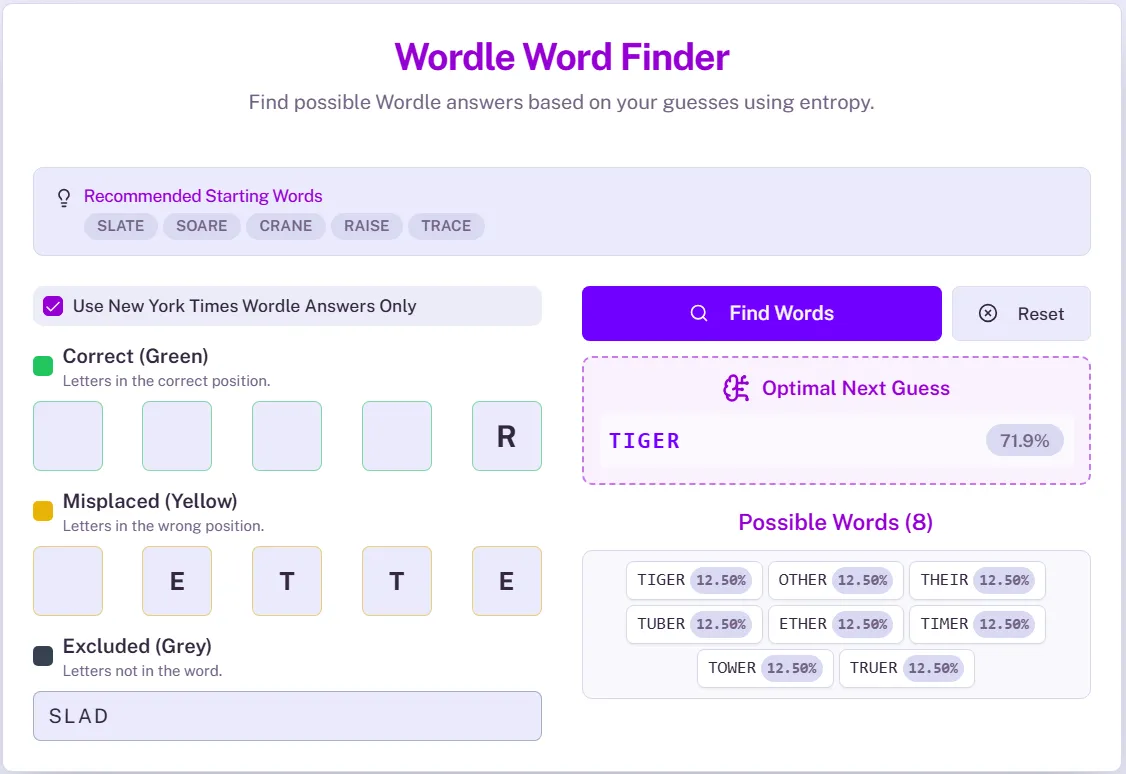
📤 Example Workflow:
-
User inputs:
- 🟩 Correct: ['s', null, null, null, 'e']
- 🟨 Misplaced: [null, 'lptm', null, null, null]
- ⬜ Excluded: "tncr"
-
The system filters the dictionary according to the rules
-
Calculates entropy for the remaining words
-
Displays up to 10 best words by probability and informativeness
📊 Statistics & Performance
| Metric | Value/Description |
|---|---|
| Average dictionary size | ~12,972 words (all) / ~2,315 (official) |
| Word reduction per click | 50–85% |
| Starting word entropies | Soare ≈ 5.89, Slate ≈ 5.87, Crane ≈ 5.84 |
| Filtering speed | <100 ms (client-side) |
| Guessed within ≤ 4 attempts | ~90% success rate |
🧠 User Experience
Despite its mathematical core,
the interface remains lightweight and intuitive.
Users received the needed suggestions in just 1–2 clicks — no learning curve.
Thanks to visual feedback and auto-processing,
even beginners quickly adapted and used suggestions effectively.
Running fully on the client ensured an instant response
and a feeling of a “live” interactive system.
📎 Conclusion
Wordle Solver demonstrates how mathematical models (entropy),
modern frontend technologies (React + Tailwind + custom hooks),
and well-designed UX can combine into a powerful and user-friendly tool.
It is not only helpful for players, but also serves as a case study of robust frontend architecture applied to real-world information analysis tasks.